
Table of Contents
- Why Horror Fans Are Moving Beyond Pixel Retro
- The Retro Resurgence in 2026
- Indie Horror Game Art Styles: What's Replacing Pixel Aesthetics
- Horror Graphic Tee Brands: Where to Find Retros' Successors
- Creepy-Cute Character Design: The New Pixel Hero
- Gothic and Distressed Aesthetics for Dark Fashion
- How to Choose Pixel Retro Alternatives That Fit Your Style
- Conclusion
- Frequently Asked Questions
Last Updated: September 10, 2026
Why Horror Fans Are Moving Beyond Pixel Retro
Horror has stopped being a seasonal hobby. According to NRG's 2026 audience study, 67% of horror fans now consume genre content all year long, and that year-round appetite is pushing fans toward pixel retro alternatives that feel fresher than the same 8-bit skulls everyone else is wearing.
Grave Humor exists because of that shift. We built our catalog around original artwork for horror, gaming, and fantasy fans who want something that doesn't look like it came off a mass-market shelf, and the demand we see confirms what the data says: fans want new visual languages, not recycled ones.
The five biggest straight horror releases of 2026 pulled in nearly $1.3 billion combined, per HorrorForever's box office roundup, so the audience is bigger than ever. The aesthetic is what's changing.
The Retro Resurgence in 2026
Retro horror isn't dying. It's mutating. Scream Horror Magazine's 2026 trend report describes retro horror as a deliberate rejection of polished, algorithm-tested filmmaking, and that same instinct drives what fans wear.
The proof sits in the box office. "Backrooms," a film built on internet-native, retro-adjacent horror, earned $81 million domestically and $118 million globally as of June 2026, according to MediaPost's box office coverage.
That success tells you something important: fans still crave the old texture, but they want it filtered through something new.
Indie Horror Game Art Styles: What's Replacing Pixel Aesthetics
Pixel art dominated indie horror for a decade because it was cheap to produce and instantly readable. Developers are now abandoning it for two reasons: market saturation and better tools. What's replacing it isn't one style, it's a cluster of styles, each tied to a different horror mood. Knowing which cluster matches the mood you want is the fastest way to sort through the noise.
Analog Horror and VHS Grain
Analog horror mimics degraded broadcast footage: static, tracking errors, timestamp overlays, and the low hum of a tape that's been recorded over too many times. It works because the imperfection itself creates dread. Where pixel art asks you to fill in gaps with imagination, analog horror hands you a corrupted artifact and dares you to look closer. The genre's breakout moment was the Local 58 series of short-form videos, which proved a whole audience would sit through a fake emergency broadcast and come back for more. In game form, this style shows up as found-footage interfaces, in-game camcorders, and menus that look like they're being played back rather than launched.
Low-Poly and PS1-Era 3D
Low-poly horror deliberately recreates the constraints of 32-bit console hardware: warped textures, short draw distances, vertex wobble, and awkward camera angles. The discomfort is the point. Fixed camera angles and claustrophobic corridors make players feel watched rather than powerful. Puppet Combo built an entire catalog on this, its PS1-style slashers trade graphical fidelity for the specific unease of a game that looks like it was pulled from a garage-sale disc. The style also has a practical upside: low-poly scenes render on almost anything, which is why so many of these titles run on decade-old laptops and handhelds without a dedicated GPU.
Hand-Drawn and Rotoscoped Horror
A smaller but growing lane abandons the retro-tech look entirely and goes hand-drawn or rotoscoped, where real footage is traced frame by frame. The result is uncanny in a different way, human motion that's almost right, which reads as deeply wrong. This style tends to pair with psychological horror rather than jump-scare horror, because the animation itself is doing the unsettling work.
Sub-Genre Cheat Sheet
Not every pixel-adjacent horror game is trying to scare you the same way. Sorting by sub-genre saves a lot of trial and error:
- Psychological: slow burn, unreliable narration, little to no combat. Best if you want dread over adrenaline.
- Survival: resource management, limited saves, inventory pressure. Best if you want tension you can lose.
- Body horror: transformation, infection, visceral imagery. Best if you want the scare to be physical.
- Campy/slasher: masked killers, chase sequences, wink-at-the-camera tone. Best if you want fun with your fear.
Accessibility and Difficulty: The Gap Most Lists Ignore
Here's the part the big recommendation lists skip. A large share of horror fans want the aesthetic without the punishing difficulty, and the good news is that many modern indie horror titles ship with difficulty modes, aim assist, reduced jumpscare intensity toggles, subtitle sizing, and colorblind palettes. If a game's store page doesn't list accessibility features, check the community forums before buying; players usually document them within weeks of launch. If you're buying for someone else, difficulty settings are the single most useful thing to confirm before checkout.
What Runs on Older Hardware
The retro audience often plays on older machines, and this is where the new art styles quietly win. Analog-horror games are frequently 2D or lightly 3D and run on integrated graphics. Low-poly titles are similarly light because the whole point is low polygon counts and short draw distances. Before buying, check the store page's minimum requirements against your machine, the usual bottlenecks are VRAM and a DirectX version, not raw CPU speed. A common pattern is that a game from this scene will run fine on a laptop that chokes on a modern AAA release.
Horror Graphic Tee Brands: Where to Find Retros' Successors
The best horror graphic tee brands in 2026 lean on original character work instead of licensed movie stills. That matters because licensed designs get reprinted by everyone, while original characters stay yours.
[Grave Humor's Twitch "Halloween Fixes Most Things" tee](https://gravehumor.myshopify.com/products/twitch-halloween-fixes-most-things) is a good example of the direction: a knife-wielding bunny holding a pumpkin beer, printed on a premium Next Level 6010 triblend for $19.99. It's dark, it's funny, and nobody else is wearing it.

Here's what separates the good options from the forgettable ones:
| What to Check | Weak Sign | Strong Sign |
|---|---|---|
| Artwork source | Stock or licensed reprints | Original character designs |
| Print method | Thin screen print that cracks | Durable DTG print |
| Fabric | Stiff 100% cotton, heavy | Triblend or ring-spun cotton |
| Production | Overseas bulk, slow updates | Printed to order, fresh releases |
Creepy-Cute Character Design: The New Pixel Hero
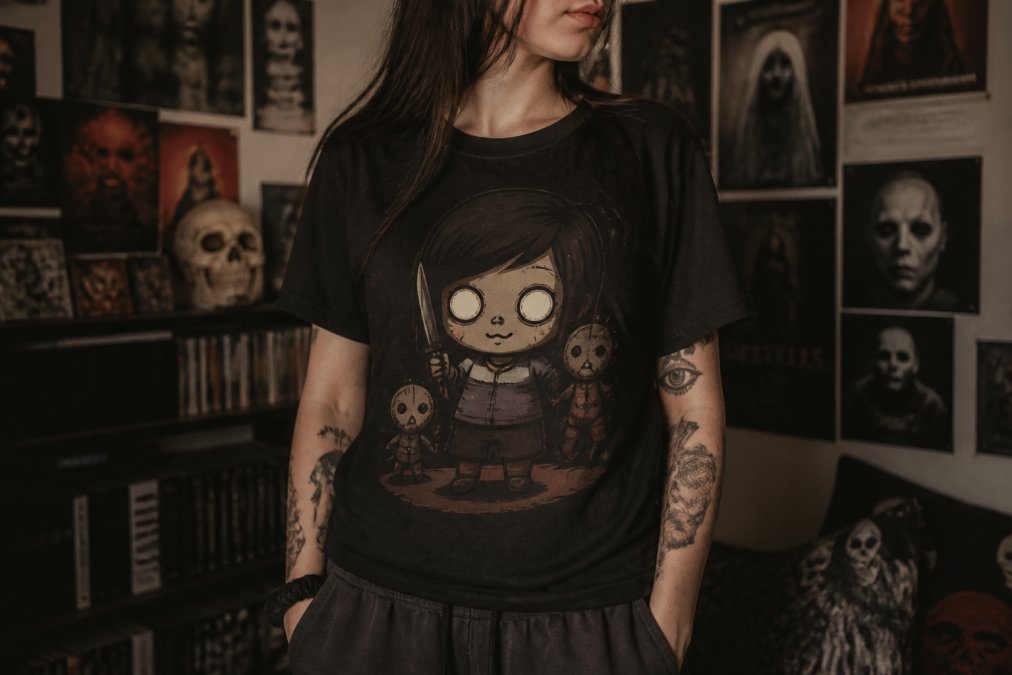
Creepy-cute is the aesthetic that replaced the pixel mascot. Instead of a blocky sprite, you get a fully illustrated character with big eyes, soft colors, and something deeply wrong underneath.
Grave Humor's Wicked Few collection runs on exactly that tension. Webster, the Many-Eyed Menace is a spider with too many eyes who'd rather let you get comfortable before striking. Grimble, the Wicked Scarecrow roams forgotten fields with a crooked scythe and an eerie grin. Both sell for $15.99 on soft Gildan 3000 cotton, and both work because the cute exterior makes the dark punch land harder.

Gothic and Distressed Aesthetics for Dark Fashion
Distressed, aged artwork is the other lane fans are moving into. Where pixel art reads as digital and clean, distressed gothic work reads as found, weathered, and older than it is.
Grave Humor's Grave Watcher tee puts a raven over a forgotten cemetery beneath a full moon, with aged tones and worn detailing that make it look pulled from another era. It's $19.99 on the same triblend build.
This aesthetic suits older fans especially. Distressed gothic artwork reads as intentional and adult in a way that bright pixel prints often don't.
How to Choose Pixel Retro Alternatives That Fit Your Style
Choosing the right pixel retro alternatives comes down to three questions: what mood you want, how the print will hold up, and whether the design will still feel right in two years. Most guides stop there. Here's the part they leave out, a concrete way to actually make the call.
Step 1: Match the Sub-Genre to the Occasion
Start with sub-genre, because it does more work than any other variable. Creepy-cute fits casual wear and conventions, it's approachable, it photographs well, and it starts conversations. Gothic distressed fits everyday and darker outfits; it reads as intentional rather than costume-y. Analog-horror and low-poly references fit gaming and tech crowds, where the audience recognizes the source material. Body-horror and slasher imagery is the most polarizing, great for a themed event, riskier for a workplace-adjacent setting.
Step 2: Check Construction Before Artwork
This is the step most buyers skip, and it's the one that determines whether you still like the shirt in a year. Print-on-demand production typically runs 2-5 business days with 3-6 days of shipping, so factor that in if you're buying a gift. On the garment itself, look for triblend or ring-spun cotton over stiff 100% cotton, and durable DTG or quality screen printing over thin prints that crack. Care matters too: machine wash cold, inside out, and tumble dry low to keep the print intact. A design you love on a thin, cracking print looks worse after five washes than a design you merely like on a durable one.
Step 3: Decide How Long You Want It to Last
Ask whether the design is a trend purchase or a wardrobe staple. Trend-driven references date fast; original character work and classic gothic motifs age well. If you're building a rotation rather than chasing a moment, weight the second category heavier.
A Quick Decision Framework
- Buying for a convention: prioritize creepy-cute or campy/slasher, and confirm shipping will land before the event.
- Buying for everyday wear: prioritize gothic distressed or original character work on a durable blank.
- Buying for a gamer: prioritize analog-horror or low-poly references, and check the design reads clearly at a glance.
- Buying as a gift: confirm the sub-genre matches the recipient's taste, and check the return policy before checkout.
The Trade-Offs Nobody Mentions
Every choice costs you something. Original artwork is more distinctive but has a smaller reference pool, so fewer people will "get it" instantly. Licensed or trend-driven designs are instantly recognizable but get reprinted by everyone, which defeats the point of an alternative. Premium blanks cost more and last longer; budget blanks cost less and fade faster. There's no universally correct answer, only the one that matches how you actually wear the shirt.
Conclusion
The pixel era gave horror fans a shared visual shorthand, and now that shorthand is everywhere, which is exactly why it stopped feeling personal. The alternatives, analog grain, low-poly dread, creepy-cute characters, and distressed gothic art, all do the same job better in 2026.
Grave Humor was built for that moment. Every design is original artwork, printed to order in the USA on premium blanks, backed by a veteran-owned operation and honest customer service. If you want a shirt nobody else at the convention is wearing, commission a custom piece.

Frequently Asked Questions
What are some good pixel games about horror?
Classic pixel horror games include 'Lone Survivor,' 'Corpse Party,' and 'The Coma: Recut.' More recent options like 'Signalis' and 'Darkwood' blend pixel aesthetics with survival horror mechanics. For fans seeking pixel retro alternatives, games like 'Faith: The Unholy Trinity' use minimalist pixel art to build dread through atmosphere rather than gore.
What are the best horror art styles for apparel beyond pixel retro?
Beyond pixel retro, horror apparel in 2026 favors creepy-cute character art, gothic distressed designs, and analog horror-inspired graphics. Brands like Grave Humor specialize in original creepy-cute characters such as Twitch the bunny and Grimble the scarecrow, printed on premium tri-blend tees. These designs appeal to fans who want dark humor without the pixelated look.
Why is the retro horror aesthetic so popular in indie gaming and fashion?
Retro horror resonates because it feels like a deliberate alternative to polished, algorithm-tested mainstream media, according to Scream Horror Magazine. In 2026, 28% of horror fans prefer classic horror over new releases, per YouGov. This nostalgia drives demand for retro-inspired apparel and games that evoke 1980s and 1990s aesthetics without feeling mass-produced.
Where can I find unique horror-themed graphic tees?
Grave Humor offers original horror graphic tees featuring characters like Morgana the witch and Webster the spider. Prices start at $15.99 for cotton tees and $19.99 for tri-blend options. Each design is printed to order in the USA, reducing waste. Their catalog includes Halloween-themed shirts, gothic artwork, and dark humor designs that stand out from mass-market retailers.
How does the Grave Humor aesthetic differ from standard pixel art?
Grave Humor uses original hand-drawn character art rather than pixelated visuals. Their Wicked Few collection features creepy-cute characters like Twitch and Grimble, blending horror tropes with dark sarcasm. Unlike pixel retro designs, these graphics emphasize detailed linework, expressive faces, and narrative-driven artwork that works on apparel without losing clarity in print.