
Table of Contents
- Why Safe Online Horror Apparel Shopping Matters in 2026
- How to Spot Fake Horror Merch Before You Check Out
- How Long Does Custom Shirt Shipping Take?
- Returns, Customer Service, and Support Red Flags
- Print-on-Demand Quality Standards and Ethical Manufacturing
- Your Buyer's Checklist for Horror Apparel
- Frequently Asked Questions
Last Updated: September 11, 2026
Why Safe Online Horror Apparel Shopping Matters in 2026
Horror apparel shopping has moved earlier and gotten bigger. According to Epsilon's 2026 Halloween marketing insights, 22% of consumers started their Halloween-related shopping between April and June, and the National Retail Federation projects record seasonal spending of $13.1 billion. That volume attracts scammers the way a porch light attracts moths. If you're hunting tips for buying horror apparel online safely, the short version is this: verify the store before you fall in love with the design, because a bootleg shirt with a cracking print is money you never get back. At Grave Humor, we sell original horror, gaming, and fantasy designs printed to order. Below, we break down the licensing tells, technical checks, and red flags that separate a legitimate shop from a scam.

How to Spot Fake Horror Merch Before You Check Out
Spotting fake horror merch comes down to two questions: is the artwork licensed or stolen, and is the store technically legitimate? Answer both before you enter payment details, and you eliminate most of the risk in a single pass. The sections below walk through the licensing side first, then the technical verification most buyers skip entirely.
Licensing, Art Theft, and Bootleg Telltales
Bootleg merchandise is apparel printed with artwork the seller has no legal right to use, whether that's stolen fan art or unlicensed film imagery. Licensed shirts carry official tags, copyright lines, or studio branding, and the seller can tell you where the license comes from. Bootlegs usually can't.
The clearest tell is the listing itself. Reverse-image-search the design; if it appears on ten different stores under ten different brand names, nobody licensed it. Community-driven recommendations consistently favor specialized horror retailers with original designs over generic marketplaces, where consumer reports of inconsistent print-on-demand quality are common. Genuine shops name their artists. Bootlegs don't have artists to name.
Technical Checks: SSL, Payment Gateways, and Domain Reputation
Secure checkout is verifiable in under a minute. Look for https:// and the padlock icon in your browser bar, which confirms an active SSL certificate encrypting your payment data. cybersecurity guidance from Florida International University experts recommends avoiding password reuse, keeping antivirus software current, and confirming that retail sites use SSL encryption before you buy.
Then check the domain itself. A store registered three weeks ago with no reviews and a too-good-to-be-true sale is a scam pattern, not a deal. 2026 online shopping safety guidance flags "too-good-to-be-true" pricing as a leading scam indicator.
Payment method matters too. Credit cards offer chargeback rights that peer-to-peer transfers and gift cards do not. If a store only accepts payment apps, walk away.
How Long Does Custom Shirt Shipping Take?
Shipping timelines matter for safety because they are one of the easiest places for a scam store to lie. A legitimate shop states production and transit windows separately and up front; a fraudulent one promises two-day delivery on a made-to-order item, which is physically impossible. Use the timeline as a verification tool, not just a convenience metric.
Print-on-Demand Timelines vs. Pre-Made Stock
Print-on-demand means your shirt is printed after you order it, which adds production days but eliminates dead inventory and waste. Pre-made stock ships faster because nothing is being made. Neither model is inherently safer, but the timeline you're promised tells you something.
Typical domestic production windows run 2-5 business days for print-on-demand and 24-48 hours for in-stock items, with transit adding 2-7 business days depending on carrier and distance. Total delivery for a print-on-demand order generally lands between 5-12 business days. Ordering in September or October, when seasonal apparel volume peaks, adds carrier delays on top of production time. If a shirt is a gift, order three weeks out.
Reading a Shipping Policy Like a Fraud Analyst
A shipping page is a document you can audit. Here is what to check, in order:
- Separate production and transit windows. A real store says "ships in 3-5 business days, arrives in 2-7." A scam store collapses both into one vague promise.
- Named carriers. USPS, UPS, FedEx, and DHL are verifiable. "International express" with no carrier name is not.
- Tracking that resolves. Ask for a tracking number format before you buy. If the store cannot tell you which carrier issues the number, the number will likely never move.
- A stated cutoff for holiday delivery. Real shops publish one because they know their own production capacity. Scam shops promise delivery right up to the holiday.
- A physical origin. A store that names its production facility or region is giving you something verifiable. "Ships from our warehouse" with no location is not.
Why the Timeline Is a Safety Signal
A store that is honest about a 10-day turnaround is telling you it knows its own supply chain. A store that promises overnight delivery on a custom-printed shirt is telling you it has never actually printed one. The timeline is not a logistics detail, it is a confession about how the business operates. Read it that way before you enter payment details.
Returns, Customer Service, and Support Red Flags
A written, specific return policy is the single strongest trust signal a small apparel store can offer, and the single easiest thing for a scam store to fake with vague language. Fit is the leading reason clothing gets returned, so a store that will not commit to a return window is a store that has already decided not to honor one.
How to Read a Return Policy for Fraud Signals
Read the policy as a contract, not a courtesy. Legitimate policies share these traits:
- A stated window. "30 days from delivery" is verifiable. "Contact us" is not.
- A named return address. A real shop gives you a physical address to ship to. A scam shop gives you a form.
- Clear condition rules. "Unworn, tags attached" is normal. "Returns at our discretion" is a door that never opens.
- Who pays return shipping. Either answer is fine; silence is not.
- Exclusions stated up front. Custom-printed items are often final sale, a real store says so before checkout, not after.
If the policy page is missing, broken, or written in generic boilerplate that could apply to any product category, treat that as a hard stop. A store that will not write a return policy will not honor one.
Testing Support Before You Buy
Email a pre-sale question about sizing, fabric, or shipping. A real store answers within one to two business days with specifics, a measurement, a fabric weight, a carrier name. A scam store either does not answer or replies with a template that dodges the question.
Red flags to log during that exchange:
- No contact page, or a contact form with no email address behind it
- A free email address (Gmail, Yahoo, Outlook) instead of a branded domain address
- No physical address or a residential address that does not match the business name
- Replies that ignore your actual question and pivot to a discount code
- Pressure to complete the purchase before you have your answer
Chargebacks: Your Real Safety Net
If a store ships nothing, ships the wrong item, or refuses a valid return, your credit card chargeback right is the mechanism that gets your money back. Peer-to-peer transfers, gift cards, and most debit transactions do not carry the same protection. This is why payment method and return policy are the same conversation: a store that only accepts irreversible payment is a store that has removed your recourse on purpose.
Keep your order confirmation, the listing page, and every support email. Most card issuers require you to attempt resolution with the merchant first, so a documented paper trail of unanswered emails strengthens your claim. File within your issuer's window, commonly 60 days from the statement date, though terms vary, and do not wait for the store to "make it right" past that deadline.
A store's response to a pre-sale question predicts its response to a problem. Ask one before you order, and keep the answer.
Print-on-Demand Quality Standards and Ethical Manufacturing
Print quality and ethics are checkable, not just marketing claims. On quality, look for direct-to-garment (DTG) or screen-printed methods with stated fabric weight and composition. DTG prints sit in the fabric fibers and hold up through repeated washing when done properly; cheap heat-transfer prints crack and peel within a few washes. Check graphic resolution in listing photos and confirm sizing charts list actual measurements, not just S/M/L.
On ethics, sustainability claims need specifics. Print-on-demand reduces waste by producing only what's ordered, but "eco-friendly" without details about materials or production location is greenwashing. A store that prints domestically and says so is giving you something verifiable.
| Quality Check | What to Look For | Red Flag |
|---|---|---|
| Print method | DTG or screen print, stated | "Premium print" with no method |
| Fabric | Stated weight and composition | No material details at all |
| Sizing | Real measurement chart | S/M/L only, no numbers |
| Production | Named country or facility | "Made overseas" vague |
| Ethics | Specific sustainability claims | Generic green language |
Your Buyer's Checklist for Horror Apparel
Run this checklist before every horror apparel purchase, and you'll catch nearly every scam and quality trap in under five minutes.
-
URL shows
https://with a padlock; SSL certificate is active - Domain has reviews or community mentions outside its own social accounts
- Return policy is written, specific, and findable
- Contact page lists a real email on the store's own domain
- Artwork traces to a named artist or official license
- Listing states print method, fabric weight, and sizing measurements
- Payment accepted via credit card or a known gateway, not gift cards
- Shipping timeline separates production from transit
- Price is plausible; deep discounts on licensed designs are a warning
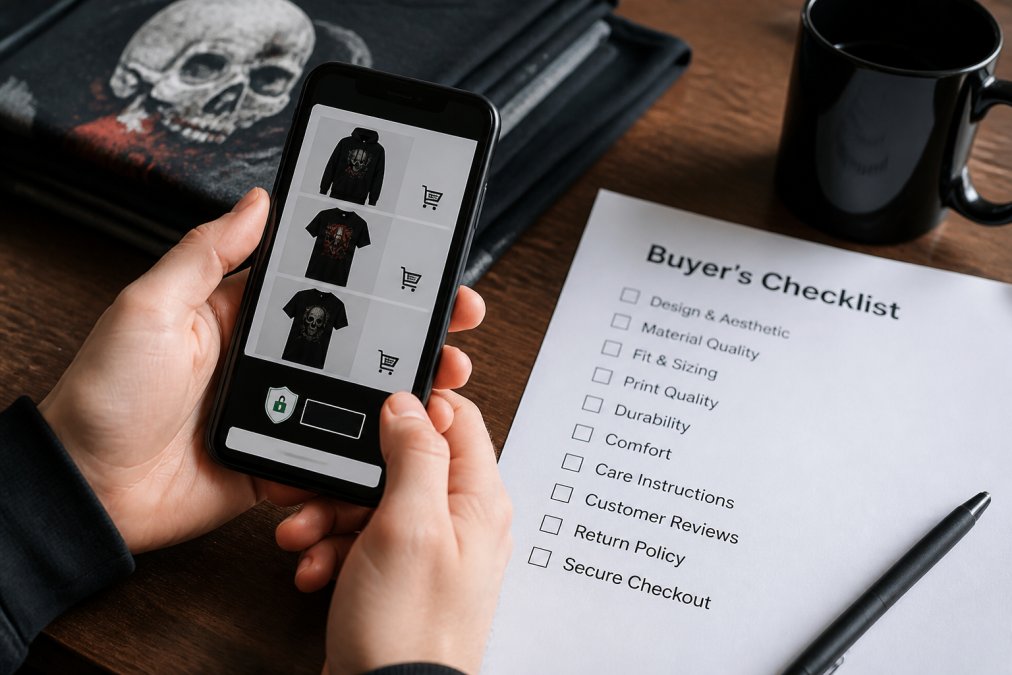
Grave Humor exists for the buyers who want original designs without gambling on a mystery store. Every design is original artwork, printed to order in the USA on soft cotton tees, with secure checkout and fast shipping.
Frequently Asked Questions
How can I tell if an online horror apparel store is legitimate?
Check for an SSL certificate (the padlock in your browser), a real domain reputation, and a published return policy. Search the brand name on Reddit for community feedback. Legitimate stores list a physical address or contact method and show real customer reviews. Per FIU cyber experts, avoid password reuse and keep antivirus software updated when shopping online.
How to spot fake horror merch?
Look for low print resolution, misspelled character names, and missing copyright or licensing marks. Bootleg items often use stolen fan art or blurry screenshots. Check fabric weight and stitching quality; counterfeits typically use thin cotton blend fabric. If the price is far below official retail and the seller has no return policy, it's likely fake.
How long does custom shirt shipping take?
Print-on-demand custom shirts usually take 2-5 business days for production plus 3-7 business days for shipping within the US. Some stores quote longer during peak season like October. Always check the shipping times listed on the product page. If a store doesn't show estimated delivery, that's a red flag. Grave Humor prints in the USA, but always confirm current timelines before ordering.
Are print-on-demand horror shirts good quality?
Quality varies by printer. Good print-on-demand uses direct-to-garment (DTG) or screen printing with durable inks. Look for details like fabric weight (e.g., 5.3 oz cotton), stitching quality, and print resolution. Cheap DTG prints can crack after a few washes. Reputable brands like Grave Humor use soft Glidan 3000 cotton tees and durable DTG prints that hold up.
What are the red flags of a scam clothing website?
Watch for prices that are too good to be true, no SSL certificate, missing contact information, and no return policy. Fake sites often have poor grammar, generic product photos, and pressure tactics like countdown timers. Check for secure checkout logos and payment gateway names like Stripe or PayPal. If the domain is new and has no reviews, proceed with caution.
Buying horror apparel online safely is a verification habit, not luck. Check the license, check the checkout, check the return policy, and you'll never fund a scam or wear a cracking bootleg again. Grave Humor is veteran owned, prints original artwork to order, and backs it with secure checkout, fast shipping, and honest customer service. Browse the original designs, or commission a custom piece and get something nobody else is wearing.