
Table of Contents
- The Honest Question: Is Print on Demand Sustainable or Just Greenwashing?
- Print on Demand vs. the Environmental Impact of Fast Fashion
- How Print on Demand Cuts Waste and Overproduction
- The Hidden Costs: Energy, Materials, and Supply Chain Reality
- What Real Eco-Friendly Print on Demand Companies Do Differently
- The Small-Batch Clothing Benefits You Can Actually Measure
- How to Verify a Brand's Sustainability Claims
- The Verdict: What Sustainable Print on Demand Gets Right and Wrong
- Frequently Asked Questions
Last Updated: September 9, 2026
The Honest Question: Is Print on Demand Sustainable or Just Greenwashing?
Consumers are ready to spend 9.7% more on eco-friendly products, according to Printful's 2026 market data report, yet the question of whether is print on demand actually sustainable remains frustratingly murky. The model produces items only after an order is placed, which sounds virtuous on paper. But the reality involves energy-hungry digital printers, global shipping networks, and synthetic materials that complicate the narrative.
At Grave Humor, we run a print-on-demand apparel business. The honest answer is that print on demand is more sustainable than traditional manufacturing in some ways and less in others. Below, we break down the environmental impact of fast fashion, the hidden costs of on-demand production, and how to verify a brand's claims.
The tension here is real: 85% of consumers report being personally affected by climate change, yet the industry still relies on processes that contribute to it Wix's print-on-demand statistics. So which is it? Let's separate the genuine waste reduction from the marketing spin.
Print on Demand vs. the Environmental Impact of Fast Fashion
Traditional apparel manufacturing produces massive quantities of deadstock, unsold inventory that often ends up in landfills or incinerators, representing one of the largest avoidable environmental costs in the consumer goods sector.
Print on demand flips this model. Instead of manufacturing thousands of units hoping they sell, products are created only after a customer commits to a purchase. This eliminates the inventory management problem entirely. The UBC Press case study documented how switching to print-on-demand and short-run digital printing successfully resolved production efficiency challenges and inventory management issues that plagued traditional publishing UBC Press case study on print-on-demand implementation.
Fast fashion operates on speculation; print on demand operates on demand. One creates waste as a structural feature, the other as an occasional exception.
How Print on Demand Cuts Waste and Overproduction
Waste reduction is where print on demand makes its strongest environmental case. By 2025, 30% of print-on-demand products were projected to be manufactured using eco-friendly materials to meet rising consumer demand Market.us Scoop print-on-demand statistics. The model inherently supports this shift because producing to order means brands can experiment with sustainable materials without risking large capital investments in unsold inventory.
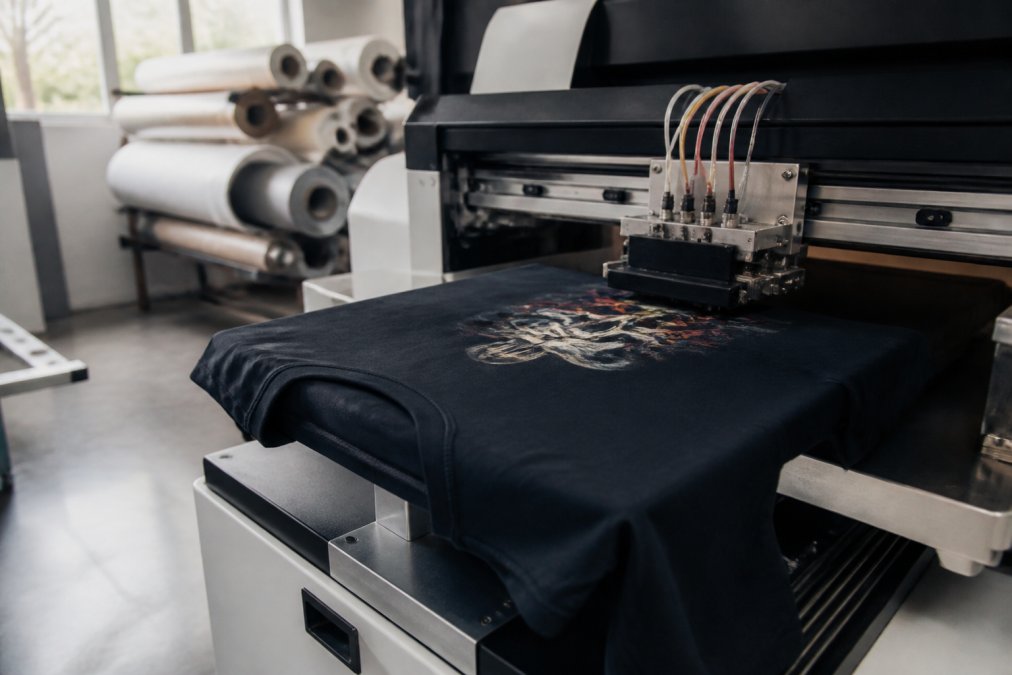
The on-demand approach reduces overproduction to near zero, no seasonal clearance sales, no deadstock crisis, no warehouses full of unsold graphic tees destined for the dump.
Small-batch benefits become measurable here. Rather than printing 5,000 units of one design, a POD operation might print 50. If the design flops, the environmental damage is minimal; if it succeeds, more units are produced on demand.
The Hidden Costs: Energy, Materials, and Supply Chain Reality
This is where greenwashing concerns get legitimate traction. A full environmental audit reveals a more complex picture, with hidden costs in three categories: energy, materials, and logistics.
The Energy Intensity of Digital Printing
Digital printing methods like direct-to-garment (DTG) are not energy-neutral. A typical DTG printer uses a pre-treatment unit, a curing oven, and the print head itself. Pre-treatment and curing require significant heat, often at 300°F or higher, consuming substantial electricity per unit compared to bulk screen printing, where energy costs are amortized over thousands of prints.
A single DTG print job might consume 0.05 to 0.1 kWh of electricity for curing and printing alone. This per-unit cost does not exist for a screen-printing run of 1,000 shirts, where energy is concentrated in setup and then spread thin. This is the 'energy consumption of digital printing' gap most sustainability guides omit.
The Material Sourcing Problem
Supply chain transparency cuts both ways. A US print-on-demand company might source blank shirts from overseas factories with questionable environmental records. The printing is local, but the material sourcing may not be. Organic and recycled fabrics cost more, and not every POD provider uses them.
The base garment, the blank t-shirt, hoodie, or tote, often represents 80% or more of the product's embedded carbon footprint. If a POD company prints on conventional cotton grown with heavy pesticide use and processed with toxic dyes, the 'on-demand' aspect does little to offset that upstream damage.
A more honest approach traces the garment's lifecycle from fiber to finished product. A blank shirt made from 100% organic cotton certified by GOTS has a verifiable chain of custody. A 'recycled polyester' blend might sound good, but recycling can be energy-intensive, and the fabric often sheds microplastics during washing.
The Logistics Paradox
Shipping efficiency presents another complication. Many POD operations use distributed fulfillment centers. A single order might print at a facility closest to the customer, reducing transport emissions, but this model fragments the supply chain.
Instead of one large shipment of 10,000 shirts to a central warehouse, a POD operation might ship 50 blank shirts to each of 20 fulfillment centers. Each smaller shipment has its own packaging, truck route, and carbon footprint. Aggregate upstream logistics can be less efficient than a centralized bulk model.
Rush production often means air freight for restocking. When a popular design sells out, blanks must be flown in to meet demand, carrying a significantly higher carbon footprint than sea shipping bulk inventory. This is the 'last-mile vs. first-mile' trade-off most promotional articles ignore.
The Greenwashing Reality Check
POD is not inherently sustainable. It eliminates overproduction but introduces new inefficiencies in energy and logistics. A brand that calls itself 'eco-friendly' solely because it uses POD is engaging in greenwashing.
To truly assess a POD company's sustainability, ask about their energy source, blank supplier's certifications, and packaging materials. If they cannot provide clear answers, that is a red flag.
What Real Eco-Friendly Print on Demand Companies Do Differently
Genuinely sustainable POD operations prioritize organic textiles and recycled fabrics over conventional cotton, one of the most pesticide-intensive crops. They use water-based inks instead of plastisol, which contains PVC and phthalates, and choose biodegradable packaging over virgin plastic.
Localization of production is another marker. ZIK Analytics reports that stores emphasizing local printing options to reduce shipping distances and eco-friendly packaging are seeing a 15% lift in marketing performance and engagement. Consumers notice and reward these efforts.
The shift toward eco-friendly materials is accelerating. Buyers increasingly prioritize organic fabrics, recycled materials, and biodegradable options across home décor and apparel Printify's industry trend analysis. Sustainable sourcing isn't just ethical positioning anymore, it's becoming a competitive requirement.
The Small-Batch Clothing Benefits You Can Actually Measure
The most quantifiable small-batch clothing benefit is waste elimination. Traditional retail operates on a forecast model that is wrong roughly half the time. Print on demand operates on a zero-inventory model where the forecast is always accurate because the customer orders first.
The print-on-demand market is projected to reach between 12.4 and 13.1 billion USD in 2026 Printway's 2026 industry projection, reflecting how mainstream this production method has become. That scale brings scrutiny, which is healthy. More players means more variance in quality and environmental commitment.
For consumers, the benefit is straightforward: you get exactly what you ordered, and nothing was manufactured that didn't need to be. The environmental cost of your garment is directly tied to your specific purchase.
How to Verify a Brand's Sustainability Claims
Verification requires asking specific questions rather than accepting marketing language. Here is a practical, four-stage audit framework covering the entire product lifecycle.
Stage 1: Material Provenance (The Input)
- What is the fiber composition? Look for organic cotton, recycled polyester, or hemp blends. Be wary of 'virgin' synthetic fibers, which are derived from petroleum.
- Where is the fiber grown or manufactured? Cotton grown in the United States is subject to different environmental regulations than cotton grown in regions with lax pesticide controls. Ask for the country of origin for the fabric, not just the final assembly.
- What certifications back the material claim? Look for third-party certifications like GOTS (Global Organic Textile Standard) for organic fibers, OEKO-TEX Standard 100 for harmful substance testing, or the Global Recycled Standard (GRS) for recycled content. A brand that uses self-designed 'eco' labels without third-party verification is a red flag.
Stage 2: Production Process (The Transformation)
- What type of ink is used? Water-based inks are preferable to plastisol, which contains PVC and phthalates. But even water-based inks have a chemical footprint. Ask if the facility treats its wastewater.
- What is the energy source for the printing facility? A facility powered by solar or wind has a lower operational carbon footprint than one using grid electricity from coal. Ask for the facility's location and check the local energy mix.
- What happens to the production waste? DTG printing generates waste in the form of misprints, test prints, and cleaning materials. Does the brand recycle these, or do they end up in a landfill?
Stage 3: Logistics and Packaging (The Journey)
- Where are the fulfillment centers located? Local production reduces shipping distances, but as noted earlier, fragmented logistics can have hidden costs. Ask if the brand uses ground shipping as the default, or if air freight is common for restocking.
- What is the packaging made of? Biodegradable or recycled materials beat virgin plastic. But also ask about the tape and labels. A cardboard box sealed with virgin plastic tape is not fully recyclable.
- Is the packaging sized to the product? Oversized boxes waste space and increase shipping emissions. A brand that uses custom-sized packaging is paying attention to the details.
Stage 4: End-of-Life Product Lifecycle (The Afterlife)
This is the stage that almost no brand addresses, the most critical gap in the sustainability conversation.
- Is the garment mono-material? A 100% cotton shirt can be composted or mechanically recycled into new fiber. A cotton-polyester blend cannot be easily separated, complicating end-of-life processing. The blend might feel soft, but it is a recycling nightmare.
- Does the brand offer a take-back program? Some forward-thinking brands are starting to offer mail-back programs where they recycle or upcycle old garments. If a brand does not have a plan for its products at end-of-life, it is not fully committed to the circular economy.
- What is the durability of the print? A design that cracks and fades after ten washes shortens the garment's useful life, forcing the consumer to buy a replacement sooner. Ask about the print's wash-test results. A high-quality DTG print should last for 50+ washes without significant fading.
The Audit in Practice
Here is a sample set of questions to ask a brand:
- What is the exact fiber composition of your base garments, and where is the fabric milled?
- Do you have third-party certifications for your materials (GOTS, OEKO-TEX, GRS)?
- What is the energy source for your primary printing facility?
- What type of ink do you use, and how is your wastewater treated?
- What is your default shipping method, and do you use air freight for restocking?
- What materials are used in your packaging, including tape and labels?
- Is your garment mono-material (e.g., 100% cotton) or a blend?
- Do you have a take-back or recycling program for your products at end-of-life?
A brand that can answer all eight questions with specific, verifiable data is likely doing the work. A brand that gives vague answers like 'we care about the environment' is likely greenwashing.
The Verdict: What Sustainable Print on Demand Gets Right and Wrong
So is print on demand actually sustainable? The answer is nuanced. Print on demand gets the waste problem right. Eliminating overproduction and deadstock addresses the most damaging aspect of fast fashion. The model aligns with what 46% of consumers report doing: buying more sustainable products specifically to reduce their environmental impact Wix consumer behavior data.
What print on demand gets wrong is the assumption that on-demand production automatically equals sustainability. Energy consumption per unit is higher than bulk manufacturing, material sourcing often remains opaque, and shipping still produces emissions. A POD t-shirt is not carbon-neutral, and any brand claiming otherwise is exaggerating.
The market saturation problem adds another layer. community discussions on print-on-demand profitability note that new sellers struggle with profitability due to high competition, which can push corners on material quality and environmental practices.
The most honest assessment: print on demand is a meaningful improvement over traditional fast fashion, not a perfect solution. It reduces overproduction while leaving room for improvement in materials, energy, and end-of-life processing. For consumers who care about waste reduction, POD is a legitimate choice. For those expecting zero environmental impact, no apparel option delivers that.
Grave Humor operates on this model, printing original designs to order in the USA. We chose POD because it aligns with our commitment to reduced waste. The system isn't perfect, but it beats producing thousands of shirts that may never find a wearer.
The environmental conversation around apparel is complex, and print on demand sits in an honest middle ground. It eliminates the waste that defines fast fashion while relying on energy-intensive digital printing and global supply chains. For shoppers who want unique graphic apparel without contributing to deadstock, the model delivers real benefits. Grave Humor combines this waste-reducing production approach with original artwork and veteran-owned operations, printed to order in the USA. If you value designs that stand out and a production method that doesn't manufacture what nobody wants, explore the collection and commission a custom piece that reflects your aesthetic.
Frequently Asked Questions
How does print-on-demand reduce textile waste compared to traditional retail?
Traditional retail relies on forecasting demand, which often leads to overproduction and massive amounts of deadstock that ends up in landfills. Print-on-demand inverts this model by manufacturing items only after a customer places an order. This on-demand manufacturing approach means products are not created unless there is a confirmed buyer, which directly minimizes textile waste and the waste management burden associated with unsold goods.
What are the main environmental drawbacks of the print-on-demand model?
The primary drawbacks are tied to the energy consumption of digital printing and the logistics of shipping individual items. While it reduces overproduction, printing one item at a time can be less energy-efficient per unit than mass production. Furthermore, items are often shipped from separate fulfillment centers directly to the consumer, which can increase greenhouse gas emissions compared to bulk shipping to a central retail location.
Are there truly eco-friendly print on demand companies?
Yes, but it requires scrutiny. True eco-friendly print on demand companies focus on the entire production cycle. They use organic textiles or recycled fabrics, water-based inks, and biodegradable packaging. Crucially, they offer supply chain transparency, allowing you to see their material sourcing and fulfillment centers. Look for specific eco-friendly certifications rather than vague claims to identify companies genuinely committed to reducing their environmental impact.
What are the benefits of small-batch clothing for the environment?
The core benefit is resource efficiency. Small-batch clothing, which is what print-on-demand enables, avoids the waste of mass production. It prevents the creation of deadstock that consumes raw materials, water, and labor only to be discarded. By printing only what is sold, small-batch production significantly lowers the carbon footprint associated with unsold inventory and helps move the fashion industry toward a more circular economy.