
Table of Contents
- The Real Economics of Print-on-Demand Clothing
- Print-on-Demand Profit Margins: What You Actually Keep
- Print-on-Demand vs. Inventory-Based Clothing: Which Model Wins?
- Startup Costs and the Low-Risk Reality
- Quality Control and What Customers Actually See
- Sustainable Fashion Business Models and Environmental Impact
- The Verdict: Is Print-on-Demand Clothing Worth Your Time?
- Frequently Asked Questions
Last Updated: September 4, 2026
The global print-on-demand market is projected to hit USD 15.19 billion in 2026, according to Mordor Intelligence's February 2026 market report, yet the question of whether print on demand clothing is worth it still sparks heated debate. At Grave Humor, we run a print-on-demand apparel business. The short answer is yes, print on demand clothing is worth it for the right operator, but the model is not the passive income machine many influencers claim. It is a real business with real margins, real operational hurdles, and real potential for those who treat it seriously.
Success depends on execution, not just uploading designs. Below, we break down the actual economics, profit margins, quality concerns, and environmental impact.
The Real Economics of Print-on-Demand Clothing
Print-on-demand clothing is a retail model where products are manufactured only after a customer places an order, eliminating the need for upfront inventory. Apparel accounts for nearly 40% of all print-on-demand sales, with t-shirts representing over 60% of those orders, per ZIK Analytics' 2026 print-on-demand statistics. This concentration means the market is deep but fiercely competitive in the basics category.
The appeal is low inventory risk: no storage fees, no unsold stock. However, this shifts risk to customer acquisition, without traffic and conversions, you make zero sales.
Print-on-Demand Profit Margins: What You Actually Keep
Typical gross profit margins for print-on-demand sellers range from 40% to 60%, according to Yoycol's profitability analysis. However, that gross figure is not what lands in your pocket. After marketing spend, platform fees, payment processing, and your own time, the net profit picture changes substantially.
Printful's 2026 seller research found that average sellers earn around a 20% profit margin, while niche or premium stores can achieve 60-70%. The gap comes down to pricing strategy and brand strength. Industry analysis from Wix's print-on-demand statistics shows successful apparel stores often price products between USD 50 and USD 100, a range where consumers have demonstrated willingness to buy.
A USD 25 t-shirt with USD 12 base cost leaves USD 13 gross; factor in USD 5 customer acquisition cost and platform fees, and you net closer to USD 6 per unit. Premium pricing, not volume, drives profitability.
| Pricing Tier | Typical Gross Margin | Net Margin After Marketing | Best For |
|---|---|---|---|
| Budget (under $30) | 40-50% | 10-15% | Volume sellers |
| Mid-range ($30-$50) | 50-60% | 20-30% | Growing brands |
| Premium ($50-$100) | 60-70% | 30-50% | Niche, branded stores |
Print-on-Demand vs. Inventory-Based Clothing: Which Model Wins?
Inventory-based clothing offers higher per-unit margins through bulk production but demands upfront capital and carries unsold-stock risk. Print-on-demand eliminates that risk: no warehouse, no dead stock, no tied-up cash.
The trade-off is higher unit costs and longer shipping times, which compress margins unless you price strategically.
For solo founders testing a niche, print-on-demand wins on cash flow and flexibility. For established brands with predictable demand, inventory production delivers better economics.
Startup Costs and the Low-Risk Reality
The barrier to entry is genuinely low on the inventory side. Most print-on-demand platforms charge nothing to start, and you only pay for products after a customer orders. Some sellers use subscription-based fulfillment services, where a monthly fee unlocks lower base costs. As seller analysis from Michael Essek notes, selling roughly 14 shirts per month covers the cost of a typical USD 29 monthly subscription.
However, the "low startup cost" narrative obscures critical legal and tax obligations. Before your first sale, address three foundational requirements:
Business Registration and Structure. Operating without formal registration exposes you to personal liability. Register your business with your state and obtain an EIN from the IRS (free, 15 minutes online). Skipping this creates compliance risk and leaves you unprotected if a customer sues.
Sales Tax Nexus and Collection. The Supreme Court's 2018 South Dakota v. Wayfair ruling requires online sellers to collect and remit sales tax in states where they have "economic nexus." For print-on-demand sellers, nexus is typically triggered at USD 100,000 in annual sales or 200 transactions per state. Once crossed, you must collect and remit sales tax quarterly or monthly.
Failing to collect and remit sales tax creates a liability that compounds monthly. Many states impose penalties and interest retroactively, which can wipe out a year's profit. The Multistate Tax Commission's guidance on remote seller obligations provides state-by-state thresholds, but the practical step is to consult a tax professional or use sales tax automation software (such as TaxJar or Avalara) that integrates with your e-commerce platform and automatically calculates, collects, and files on your behalf. This typically costs USD 20-50 per month but is non-negotiable for compliance.
Payment Processing and Chargeback Reserves. Credit card processors hold a reserve, typically 5-10% of monthly revenue for 6-12 months, to cover chargebacks and refunds. This creates a cash-flow lag: USD 5,000 in sales may yield only USD 4,500 in your account. Processors also charge 2.9% + USD 0.30 per transaction, reducing net take-home.
Realistic First-Year Budget:
- Business registration and EIN: USD 0-50
- Sales tax software: USD 240-600/year
- E-commerce platform: USD 348-3,588/year
- Domain and SSL: USD 12-20/year
- Design software or freelance design: USD 120-960/year
- Product samples: USD 50-200
- Paid traffic testing: USD 500-2,000
Total: USD 1,500-5,500 first year, before generating a single sale. This is real capital required before profitability is possible.
Quality Control and What Customers Actually See
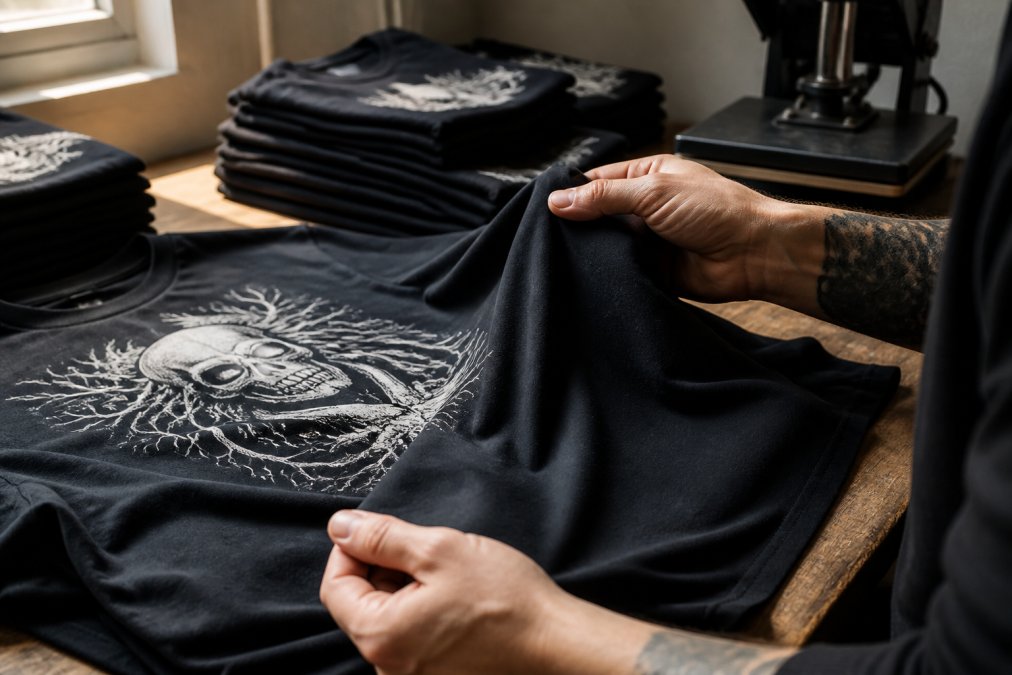
Quality control is where many sellers fail. Print quality and garment selection determine returns and reviews. When relying on a fulfillment partner, vendor selection and systematic testing are non-negotiable.
The Sample-Ordering Protocol. Order and inspect 3-5 units of each core product across multiple print methods. Test rigorously: wash samples 5-10 times for print durability; check fabric weight and feel (quality t-shirt blanks are 5.3-6.0 oz); compare color accuracy to digital mockups; measure sizing against vendor charts; assess packaging and unboxing experience.
Vendor Evaluation Scorecard. Use a structured scorecard to compare fulfillment partners objectively. Rate each vendor on these criteria (scale of 1-5):
| Evaluation Criterion | Weight | Notes |
|---|---|---|
| Print quality (sharpness, color accuracy) | 25% | Most important; directly impacts customer satisfaction |
| Fabric quality and feel | 20% | Premium feel justifies higher pricing |
| Durability (wash testing results) | 20% | Cracking or fading triggers returns and refunds |
| Shipping speed (days to fulfillment) | 15% | Faster fulfillment reduces customer wait time and cart abandonment |
| Customer service responsiveness | 10% | Critical when issues arise; test with sample questions |
| Pricing (base cost per unit) | 10% | Lower base costs improve margins, but not at the expense of quality |
Multiply each score by its weight and sum the results. A vendor scoring 4.2+ is reliable; below 3.5 indicates quality or service gaps that will hurt your brand.
Common Quality Pitfalls and Red Flags. Watch for these vendor behaviors that signal quality or reliability issues:
- Inconsistent print placement. If your logo shifts left or right across samples, the vendor's equipment is not calibrated properly. This is a deal-breaker.
- Thin or cheap-feeling blanks. Budget garments feel thin and wear poorly. If a t-shirt feels like tissue paper, customers will notice and leave negative reviews.
- Long fulfillment times. If a vendor takes 7-10 business days to print and ship, customers may cancel orders or leave negative reviews before the product arrives. Aim for 3-5 business days.
- Unresponsive customer service. Email a test question to the vendor's support team and time the response. If they take 48+ hours to reply, escalation will be slow when problems arise.
- Hidden fees or minimum orders. Some vendors advertise low base costs but charge setup fees, art fees, or require minimum order quantities. Read the fine print.
Ongoing Quality Monitoring. After launch, monitor reviews and returns for quality complaints; order fresh samples quarterly to catch quality drift; track return rates, if exceeding 5%, investigate for quality issues.
Sustainable Fashion Business Models and Environmental Impact
Print-on-demand eliminates overproduction waste, a genuine advantage over inventory retail. However, decentralized fulfillment can increase shipping emissions. For sustainability-focused brands, choose fulfillment partners with efficient processes and responsible sourcing. On-demand production reduces waste but is not a complete solution to fashion's environmental challenges.
The Verdict: Is Print-on-Demand Clothing Worth Your Time?
Print-on-demand clothing is worth it for entrepreneurs who treat it as a real business with a clear niche, premium pricing, and quality commitment. It is not worth it for anyone expecting passive income from uploaded designs. Winners build brand identity, focus on customer retention, and price in the premium range. Start small, order samples, and invest in original designs for a specific audience. The opportunity rewards effort and strategy, not shortcuts.
=== FAQ ANSWERS (ARTICLE CONTENT, AUDIT EACH ONE SEPARATELY, SAME RULES) ===
[1] Q: Is print-on-demand still profitable in 2026? A: Yes, but profitability depends on execution. The industry is projected to reach USD 15.19 billion by 2026, with apparel accounting for 40% of sales. Typical gross profit margins range from 40% to 60%, though average sellers earn closer to 20%. Success requires strategic pricing (USD 50-USD 100 for apparel), niche selection, and genuine marketing effort rather than passive uploads. Premium and niche-focused stores consistently outperform generic competitors.
[2] Q: What are the main disadvantages of print-on-demand? A: The biggest drawbacks are thin margins for beginners, longer shipping times compared to inventory-based retailers, quality variability across fulfillment partners, and intense competition in saturated niches. You also lack control over production and must rely on third-party fulfillment, which limits customization. Customer acquisition costs can eat into profits, and success requires treating it as a real business, not passive income. Print quality and garment selection directly impact brand reputation.
[3] Q: How does print-on-demand reduce textile waste? A: Print-on-demand only produces items after purchase, eliminating unsold inventory that typically ends up in landfills. Traditional retail creates excess stock that often goes to waste; POD eliminates this overproduction. However, environmental benefit depends on sustainable fulfillment practices, ethical sourcing of base garments, and shipping efficiency. Choosing providers committed to eco-friendly processes and selecting quality garments that last longer amplifies the sustainability advantage over fast-fashion alternatives.
[4] Q: What should I look for in a print-on-demand fulfillment partner? A: Evaluate partners on print quality, shipping times, garment selection, pricing structure, customer support responsiveness, and integration with your e-commerce platform. Request product samples before committing, this directly impacts your brand reputation. Check their return policy, quality control processes, and whether they offer white-label options. Compare base costs against retail pricing to ensure your profit margins work. Automated workflow integration saves time; look for partners offering real-time inventory updates and order tracking.
Frequently Asked Questions
Is print-on-demand still profitable in 2026?
Yes, but profitability depends on execution. The industry is projected to reach USD 15.19 billion by 2026, with apparel accounting for 40% of sales. Typical gross profit margins range from 40% to 60%, though average sellers earn closer to 20%. Success requires strategic pricing (USD 50-USD 100 for apparel), niche selection, and genuine marketing effort rather than passive uploads. Premium and niche-focused stores consistently outperform generic competitors.
What are the main disadvantages of print-on-demand?
The biggest drawbacks are thin margins for beginners, longer shipping times compared to inventory-based retailers, quality variability across fulfillment partners, and intense competition in saturated niches. You also lack control over production and must rely on third-party fulfillment, which limits customization. Customer acquisition costs can eat into profits, and success requires treating it as a real business, not passive income. Print quality and garment selection directly impact brand reputation.
How does print-on-demand reduce textile waste?
Print-on-demand only produces items after purchase, eliminating unsold inventory that typically ends up in landfills. Traditional retail creates excess stock that often goes to waste; POD eliminates this overproduction. However, environmental benefit depends on sustainable fulfillment practices, ethical sourcing of base garments, and shipping efficiency. Choosing providers committed to eco-friendly processes and selecting quality garments that last longer amplifies the sustainability advantage over fast-fashion alternatives.
What should I look for in a print-on-demand fulfillment partner?
Evaluate partners on print quality, shipping times, garment selection, pricing structure, customer support responsiveness, and integration with your e-commerce platform. Request product samples before committing, this directly impacts your brand reputation. Check their return policy, quality control processes, and whether they offer white-label options. Compare base costs against retail pricing to ensure your profit margins work. Automated workflow integration saves time; look for partners offering real-time inventory updates and order tracking.
Starting a print-on-demand clothing business requires navigating design, quality, and customer trust challenges. Grave Humor demonstrates how the model works in practice, offering original artwork printed to order in the USA with fast shipping and secure checkout. If you are ready to build a brand around unique, high-quality apparel, explore the collection and commission a custom piece today.
This article was written using GrandRanker