
Table of Contents
- The Real Cost of Cheap Graphic Tees
- Why Are Graphic Tees So Expensive? Breaking Down the Price Tag
- Durability of Domestic vs Imported T-Shirts: What Lasts Longer
- How to Identify High Quality Graphic Tees Before You Buy
- Ethical Manufacturing and Labor Standards in US Apparel
- The Environmental Impact of Local Production and Print-on-Demand
- Why Choose US-Made Graphic Shirts for Your Wardrobe
- Frequently Asked Questions
Last Updated: September 17, 2026
The Real Cost of Cheap Graphic Tees
Graphic t-shirts account for more than 57% of revenue in the custom printing segment, according to National Law Review's analysis of t-shirt industry statistics, and that dominance hides a hard truth: the cheapest shirt on the rack is rarely the cheapest shirt you'll own. A $7 tee that fades, shrinks, and cracks after three washes costs more per wear than a well-made shirt at triple the price. That math is the entire argument for why choose us made graphic shirts, and it's the thread running through this guide from Grave Humor.
Here's what most buyers get wrong: they compare sticker prices, not cost per wear. A shirt you actually keep for two years beats five shirts you replace every season.
Below, we break down where your money goes, how domestic and imported tees differ in durability, and how to spot quality before you check out.
Why Are Graphic Tees So Expensive? Breaking Down the Price Tag
The price of a graphic tee reflects four costs: the blank garment, the print method, the labor behind both, and the margin the seller needs to stay open. Imported blanks keep the first cost low. Domestic production raises it, and that gap is real, not marketing.
The global t-shirt market is projected to reach $202.84 billion by the end of 2026, per Cognitive Market Research's t-shirts market analysis, while the custom printing side is growing even faster, from $6.3 billion in 2025 toward $9.8 billion by 2030, according to Grand View Research's custom t-shirt printing market report. That growth is driven by demand for personalized apparel, and it means more sellers competing on price. Price competition usually comes out of fabric weight, print quality, or labor.
Apparel made domestically typically carries a higher price tag than mass-produced imports because of labor and production costs, per Red White Blue Apparel's analysis of domestic production costs. You are paying for the difference between a shirt made under enforceable wage and safety rules and one made under whatever the lowest bidder accepts.
Durability of Domestic vs Imported T-Shirts: What Lasts Longer
Domestic tees generally outlast imports because the fabric is heavier, the stitching is denser, and the print is cured properly. Imported shirts often use lighter cotton blends and thinner thread, which shows up as stretched collars and cracked graphics within months. But "heavier" and "denser" are meaningless without numbers, so here is the technical breakdown most buying guides skip.
Fabric weight, measured in GSM (grams per square meter). This is the single best predictor of how a shirt will age. A common pattern in the trade:
- Lightweight (roughly 120-150 GSM): Typical of fast-fashion and promotional blanks. Thin, semi-translucent, prone to collar stretch and hem curl after a dozen washes.
- Midweight (roughly 150-180 GSM): The standard range for retail graphic tees. Holds shape reasonably well and is the floor for a shirt you intend to keep.
- Heavyweight (roughly 180-220+ GSM): The range most domestic and premium blanks target. Drapes with structure, resists thinning, and survives repeated washing without going sheer at the shoulders.
Thread count and yarn size. Thread count describes how many threads are woven per square inch; yarn size is expressed in "singles", the higher the singles number, the finer the yarn. A 30-singles (30s) ring-spun cotton uses finer, longer-staple fibers than a 20s open-end yarn, which is why a 30s shirt feels smoother and pills less over time. Finer yarn does not automatically mean weaker: ring-spun 30s cotton, properly knit, outlasts a coarser 18s or 20s open-end fabric because the fibers are longer and twist more tightly.
Stitching and construction. Look for double-needle hems, taped neck and shoulder seams, and side-seamed (not tubular) bodies. Tubular construction, a single tube of fabric with no side seams, is cheaper to produce but twists after washing and cannot be tailored to fit. Side seams cost more and hold their shape.
Print method and cure. Direct-to-garment (DTG) and screen printing both bond ink to fiber when cured at the correct temperature and dwell time. Under-cured plastisol sits on top of the fabric and cracks along the design's stress lines; properly cured ink stretches with the cotton. A simple field test: stretch the printed area gently. If the ink cracks or feels like a separate plastic layer, the cure was rushed.
Dye quality. Low-impact certified dyes (look for OEKO-TEX or bluesign references on the label) resist fading across dozens of wash cycles.
How to Identify High Quality Graphic Tees Before You Buy
High-quality graphic tees share five checkable traits: substantial fabric weight, reinforced seams, a cleanly cured print, consistent sizing, and a care label that tells you what you're actually buying. You can verify all five in under a minute, even online.
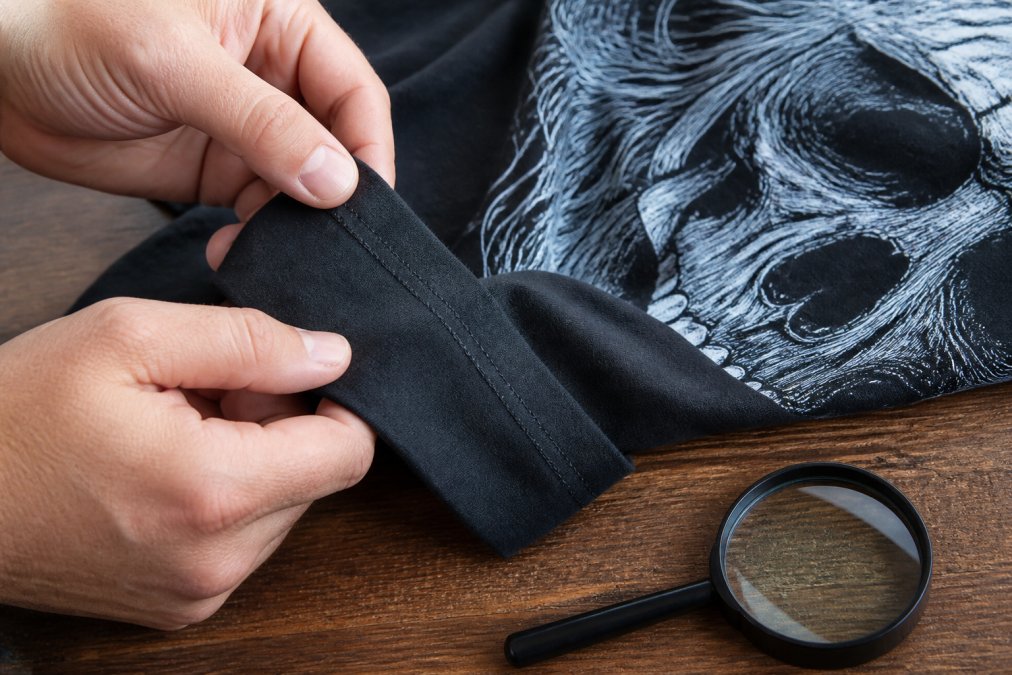
Use this checklist before you commit:
- Fabric is 100% cotton or a clearly stated blend, not an unlabeled mystery mix
- Neck and shoulder seams are taped, not raw
- Print edges are sharp with no visible cracking or bleeding
- Sizing chart lists actual measurements, not just S/M/L
- Care instructions are specific (wash temperature, drying method)
| What to Check | Weak Signal | Strong Signal |
|---|---|---|
| Fabric | Unlabeled blend | 100% cotton, stated weight |
| Seams | Raw edges | Taped neck and shoulders |
| Cracks when stretched | Sharp edges, cured DTG | |
| Sizing | S/M/L only | Full measurement chart |
| Care | Vague | Specific wash and dry temps |
Ethical Manufacturing and Labor Standards in US Apparel
Domestic apparel production is subject to enforceable wage, safety, and overtime rules that many overseas factories operate outside of. That regulatory floor is the practical difference buyers are paying for when they choose domestic, but "enforceable rules" is a slogan until you know which rules and how to check them.
- Ask for the mill and the cut-and-sew facility by name. A domestic supplier should be able to name both. "We source ethically" is not an answer.
- Request the fabric spec sheet. GSM, singles, fiber content, and dye certification should be on paper, not in a sales call.
- Confirm the print method and cure temperature. DTG and screen print have different durability profiles; a supplier who cannot state the cure spec is outsourcing the print.
- Ask about minimum order quantities (MOQs) and lead times. Domestic production typically carries higher MOQs and shorter lead times than overseas; a supplier claiming overseas-level MOQs on domestic goods is likely brokering, not manufacturing.
- Check for a business license and a physical production address. A domestic manufacturer has both. A drop-shipper does not.
- Ask what happens when a print fails. A real domestic supplier stands behind the cure and reprints defective units. A broker disappears.
The Environmental Impact of Local Production and Print-on-Demand
Print-on-demand reduces waste by producing only what's actually ordered, which cuts the dead inventory that traditional retail discards at the end of every season. The print-on-demand industry reached $27.1 billion in sales in 2025, per [Wix's print on demand(/blogs/news/is-print-on-demand-actually-sustainable-2026-honest-look) statistics report | wix.com], and that scale means the model is now mainstream, not a niche experiment.
Where local production adds environmental value:
- Shorter shipping distances reduce the carbon footprint of getting a shirt to your door
- Domestic textile production operates under U.S. environmental rules
- Print-on-demand eliminates unsold stock that gets landfilled
- Certified low-impact dyes and reduced plastic packaging cut secondary waste
Why Choose US-Made Graphic Shirts for Your Wardrobe
US-made graphic shirts deliver better cost per wear, clearer labor standards, and print quality that survives real use. The case isn't patriotism; it's math and construction.
Frequently Asked Questions
Are American-made graphic tees more durable than imported alternatives?
Domestic production often uses tighter quality control and higher-grade cotton, which can improve durability. Imported tees may use thinner fabrics or lower-quality inks that fade or crack faster. The durability of domestic vs imported t-shirts depends on the specific manufacturer, but US-made options like those from Grave Humor use 100% US cotton and durable DTG printing for longer wear.
Why are graphic tees so expensive compared to plain shirts?
Graphic tees cost more because of the design, printing process, and often higher-quality materials. Custom printing adds labor and ink costs. US-made shirts also carry higher labor and production expenses than imported goods. However, the price reflects better durability, ethical manufacturing, and original artwork, which plain mass-produced shirts lack.
How can I tell if a graphic tee is high quality before ordering online?
Look for fabric weight (heavyweight or 100% cotton), stitching details like taped neck and shoulders, and print methods such as DTG or screen printing. Check for certifications like OEKO-TEX low-impact dyes. Reviews about wash resistance and fit consistency also help. Grave Humor lists specs like 100% US cotton and durable DTG print, so you know what you're getting.
What does 'Made in the USA' actually mean for graphic shirts?
It means the shirt was manufactured domestically, often with US-grown cotton and US labor. This can indicate better quality control, ethical labor standards, and support for the local economy. However, not all US-made claims are equal; look for transparency about supply chain and materials. Grave Humor prints in the USA on 100% US cotton tees, ensuring domestic production.
Cheap graphic tees are a subscription you didn't sign up for: replace, repeat, replace again. Grave Humor prints original horror, gaming, and fantasy designs to order on 100% U.S. cotton tees, with durable DTG printing, taped neck and shoulders for real durability, and production in 2-5 business days with shipping in 3-6. Get started with Grave Humor and build a wardrobe of shirts that survive the wash cycle.